
How to Scan a Business Card on iPhone
Yes, an iPhone can read a business card with no scanner app installed. Photograph the card, open it in Photos and tap the Live Text button, and the printed text becomes something you can select and copy. The Copiya app is for the part that gets tedious, which is going back to the photo for every field.
Photograph the card, then take the text off it
The feature that reads a card is Live Text, and Apple documents it on a saved photo. If you came here looking for a business card scanner or card reader, try this before installing one. The steps follow Apple's Copy and translate text from photos on your iPhone or iPad page, published May 1, 2026.
- Take a photo of the card and open it in Photos.
- Tap the Live Text button in the lower-right corner of the photo to highlight the text.
- "Touch and hold a word and move the grab points to adjust the selection," then tap Copy. To take all of the text in the photo, tap Select All and then tap Copy, because Select All only selects.
That takes the text Live Text has picked up, free, with nothing installed.
This works without saving a photo too. Apple: "You can also use Live Text in the Camera app or when using Camera in apps like Notes or Reminders," where you "point your camera at a photo or image with text, then tap the Live Text button." The example Apple walks through is a photo or image with text rather than a card held in front of the lens. Hold a card in the viewfinder and see whether the button appears.
One requirement, in Apple's words: "To use Live Text, you need an iPhone XS, iPhone XR, or later with iOS 15 or later."
Getting the card into Contacts
The phone number and the email address behave differently from the rest of the card. Apple: "Tap the phone number or email address that appears to call or send an email. Depending on the photo, image, or website, you might see the option to Make a FaceTime call or Add to Contacts."
Two things worth knowing before you tap.
- That tap is documented as the way to place a call or start an email. Add to Contacts is listed as something you "might see" alongside it, and neither page we read names a setting that turns it on.
- Apple's page names a phone number and an email address. It describes no equivalent tap for a person's name, their job title, their company or the street address.
The route that does not depend on anything optional is the plain one:
- On the photo, tap the Live Text button, then touch and hold a word and move the grab points over the line you want.
- Tap Copy.
- Open Contacts, start a new entry and paste it into the right field.
- Go back to the photo, tap the Live Text button again, and take the next line.
If the contact belongs in another address book app
Change step 3 only. Copy each line the same way, then create the contact in the app that owns the address book you want it in and paste the lines into its fields. This guide does not cover Outlook's or Google Contacts' own card scanning, which we did not test. We also did not verify which account a new iPhone contact is filed under. Do one card and go look for it where you expect it before working through the rest.
Filing the card itself in Notes
To keep the card rather than turn it into a contact, open Notes, start a note and tap the Attachments button. Apple's Scan text and documents in Notes using the iPhone camera page puts two commands there.
- Tap Scan Documents, hold the card under the camera, and the page describes your iPhone capturing it automatically once it detects the page boundaries. That description is written for a page. Watch whether it fires on its own for one card before you trust it with a stack.
- Tap Scan Text, point the camera, select with the grab points, then tap Insert to drop the words into the note.
A scanned document is saved as a PDF in the note. Neither command is described as creating a contact.
The Copiya way: fewer trips back to the photo
The last two steps of that Contacts route are the slow part, because each field means switching apps and coming back. The Copiya app reads the text shown on your screen and can hold several pieces, so you take the card apart in one sitting and fill the contact in afterward.
Install it, then set the trigger once in Settings > Accessibility > Touch > Back Tap > Double Tap and choose Copiya. On iPad the trigger is Copiya Select in Control Center (iPadOS 18 or later) or an AssistiveTouch shortcut. With the photo of the card on screen:
- Double-tap the back of your iPhone.
- Tap the first word you want, such as the person's first name.
- Tap the last word, such as the end of their job title. You can leave words out of the middle of a selection.
- Tap Copy to paste it right away, or Copy to Copiya Clipboard to keep it for later.
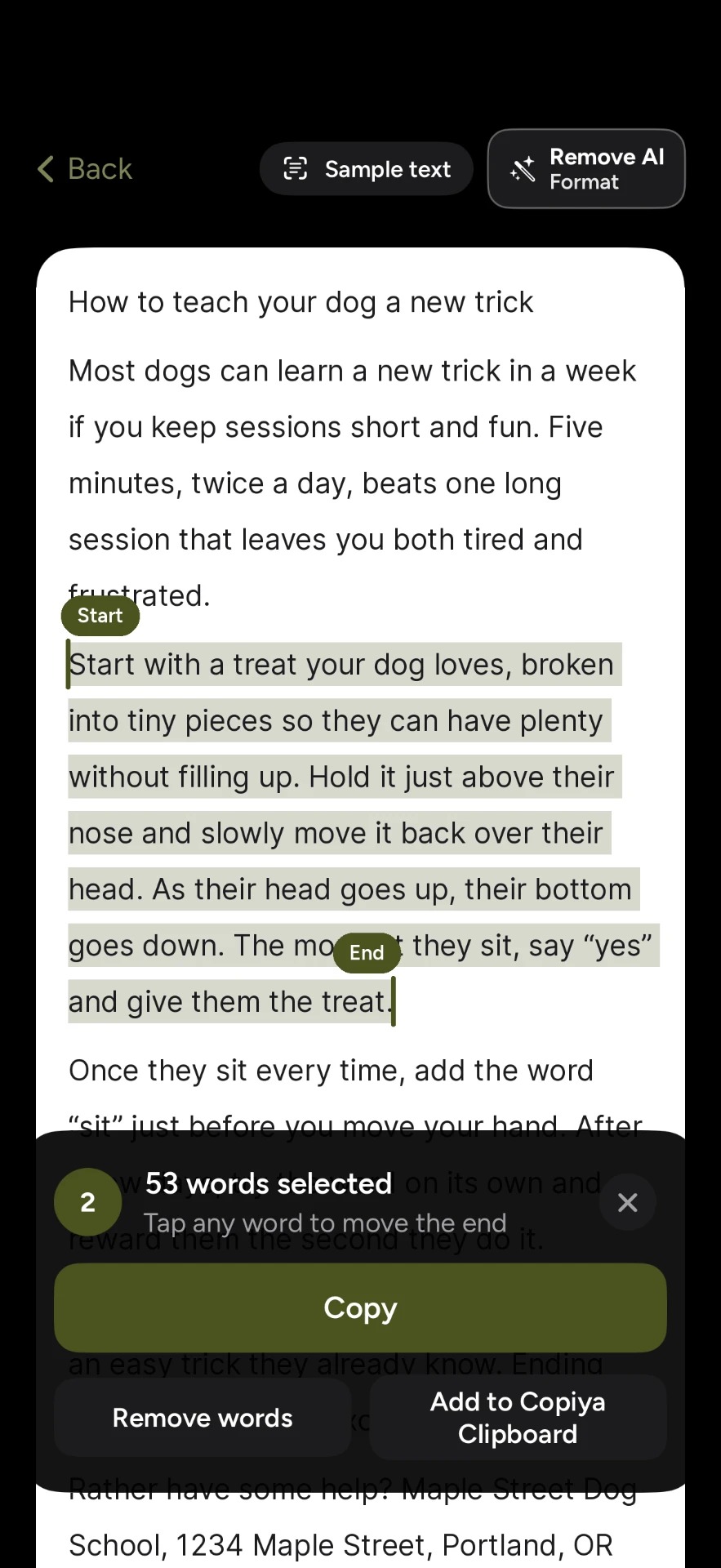
Phone numbers, email addresses and street addresses show in green, and one tap copies just that item. Apple's page describes no tap action for the street address, and it is the line you would otherwise retype in full.
The two buttons behave differently, and on a card the difference decides your order of work. Text copied with Copy goes to the system clipboard and stays there for 60 seconds, which suits you when Contacts is your very next tap. A piece saved to Copiya Clipboard keeps until you delete it, so you can take the name, the company and the address in a row and come back for each one while you fill the entry in. You still paste them one at a time.
There is no account and the text is read on the device. 25 copies are free for life and Copiya Premium is unlimited, at $2.99 a month, $19.99 a year or $29.99 once, with a 14-day free trial.
Copiya copies text. It does not build the contact for you. The same selection on any picture is in how to copy text from a picture on iPhone, and the gesture setup is in Back Tap on iPhone.
Is there a business card scanner or reader built into iPhone?
Neither Apple page we read describes one. Live Text is what the phone gives you, and it covers the reading without an install.
We have not tested third-party card scanners, and we are not going to rate them. What we would do instead is run a candidate through one card whose details you already know:
- Does it fill the name, job title, company and address, or only the number and the email?
- Does it read the languages and scripts you are actually handed?
- Where does the contact land, and can you pick the account before it saves?
- Does it keep the picture of the card with the contact?
- What does the free tier allow before it asks for money?
Check the first and the last of those before paying for anything. For the text tools covered on this site, see copy and paste apps compared.
When the card will not scan, or scans wrong
- No text is picked up: check the iPhone against Apple's requirement above, and check that the Live Text button appears on the photo at all. Apple points to its feature availability page for the regions and languages Live Text supports. Its path for turning Live Text on is Settings > General > Language & Region, where you turn on Live Text.
- Some lines read and others do not: try again with the card flat, filling more of the frame and turned away from direct glare, then compare the two photos.
- A card printed on both sides: photograph each side separately and treat the back as its own pass.
- Check what came across: read a scanned number back against the card digit by digit before you save it. A misread digit will not announce itself, and you find out when the call fails.
Copying the picture of the card rather than the words on it is a different job: see how to copy a picture on iPhone.
Questions people ask
Is there a free business card scanner app for iPhone?
Before you look for one, the reading part already costs nothing. Live Text works on a saved photo of the card, and Apple says it works in the Camera app as well, though the example Apple walks through there is a photo or image with text rather than a card in your hand. Test the viewfinder before relying on it. We have not tested any paid or free third-party scanner. The thing to compare one against is what the built-in route already gives you, not the app's own description of itself.
Can I scan a business card straight into Contacts in one step?
Not from anything we read. Apple documents a tap on a detected phone number or email address, with Add to Contacts as an option you might be offered, and nothing that takes a whole card in one action. We have not tested any third-party scanner. The question worth putting one through first: does it fill the name, job title, company and address, or only the number and the email?
Does this work on a visiting card or a name card?
Yes, the steps are the same whatever the card is called. The one thing to watch is the language printed on it, and the quickest test is a card you can already read: if Live Text highlights the Latin-script lines on a bilingual card and leaves the rest alone, the script is the limit rather than the photo. Apple points to its feature availability page for the languages and regions Live Text supports.
Can I scan business cards on an iPad the same way?
Apple's page lists Live Text for iPad too, covering iPad Pro (M4) and iPad Air (M2) models, iPad Pro 11-inch (all models), and iPad, iPad Air and iPad mini from the 8th, 3rd and 5th generations onward, on iPadOS 15.1 or later. The one thing that changes for Copiya is the trigger, because iPad has no Back Tap to double-tap: use Copiya Select in Control Center on iPadOS 18 or later, or an AssistiveTouch shortcut.
What is the best way to handle a stack of business cards?
Photograph them as they are handed to you and leave the typing until you can sit down, rather than scanning each one in the moment. Then work down the camera roll a photo at a time. If you are using Copiya, Copiya Clipboard is where a line you took at the start of the stack is still sitting when you finally reach its field.